


How Drought-Tolerant Plants Fit Into Holiday Lighting Design
Last Updated: November 22, 2026
Quick Summary
Incorporating drought-tolerant plants in residential gardens means choosing sturdy, water-wise species that hold their shape all year, giving holiday lights a frame to shine against. Group them by water need, plant by shape first, and route light runs along bed edges away from sprinkler heads.
Drought-tolerant plants keep their form through winter and hold up under clips, stakes, and cords.
Fix soil drainage before planting, since good drainage decides whether drought-resistant landscaping survives its first year.
Space tall shrubs 4-6 feet apart and plant trees at least 8-10 feet from the house.
Water new plants every 2-3 days for the first two weeks, then once or twice a week through week 12.
Leave a 12-18 inch buffer between sprinkler heads and light stakes to avoid collisions.
Want plants and lights that work together?
AF Lawn and Light designs water-wise landscapes and custom holiday lighting for homes across the metro.
Table of Contents
Step 2: Choose Low-Maintenance Drought-Tolerant Plants That Frame Lights
Drought-Resistant Landscaping Ideas That Make December Easier
Drought-Tolerant Landscaping Plants by Role: Trees, Shrubs, Grasses, and Ground Covers
Step 3: Group Plants by Water Needs and Plan Your Light Runs
Designing a Drought-Tolerant Front Yard That Carries a Holiday Display
Step 4: Safely Route Lighting Around Water-Wise Garden Features
Why Drought-Tolerant Plants Belong in a Lit Landscape
A holiday light display looks best when it has something to shine against. Bare walls and empty beds leave strings of lights floating in the dark.
Drought-tolerant landscaping means choosing plants that survive on rainfall and minimal watering once established. These plants tend to be tough, structured, and low-maintenance.
Here is the key point most guides miss: a plant that needs constant watering is a plant you will fuss over in July and ignore in December.
They keep their form through winter
They need less watering and less replanting
They give lights texture, height, and contrast
Step 1: Assess Sun, Soil, and Drainage Before You Plant
Start by watching your yard, not shopping for plants. Spend a week noting where sun hits and where water pools. This saves you from planting the wrong thing in the wrong spot.
Reading Your Yard's Dry Spots and Wet Spots
Walk your yard after a rain and look for two things. First, find the spots that dry out fast, usually higher ground or areas near paving. Second, find the low spots where water sits. Dry soil suits most drought-tolerant plants. Wet soil needs a different list entirely.
Check your soil type with a simple squeeze test. Grab a handful of damp soil and squeeze it. If it crumbles, it drains well. If it holds a tight ball, it needs drainage help.
Full sun: six or more hours, best for most drought-tolerant plants
Part shade: good for perennials and ground covers
Low, wet spots: pick water-loving plants or add drainage
Fix soil drainage before you plant anything. Mix in compost and, on heavy clay, build a slight mound so roots never sit in water.
Step 2: Choose Low-Maintenance Drought-Tolerant Plants That Frame Lights
Pick plants for their shape first and their flowers second. A plant that looks good in July but flops in winter gives your lights nothing to work with. The best low-maintenance drought-tolerant plants hold a clean outline all year.

Structural Plants for Wrapping and Uplighting
Some plants are built for lights. Upright trees and tall shrubs let you wrap trunks and uplight branches. Think of a crepe myrtle with a smooth trunk, or a juniper with a tight, cone shape.
For mid-height glow, rosemary, Russian sage, and butterfly bush bring soft texture. Ornamental grasses catch low light and move in the wind, which makes even simple strands look alive.
Wrap trunks of upright trees and shrubs
Uplight broad woody ornamentals from below
Tuck short strands into ornamental grasses
Drought-Resistant Landscaping Ideas That Make December Easier
Design the yard so December setup is simple. For seasonal prep that pairs with your display, see these fall lawn care tips. That is the idea behind smart drought-resistant landscaping ideas: fewer surprises, easier installs, and a display that looks planned rather than patched together.
A few moves pay off every year:
Run a stone pathway or gravel edge to mark where lights go
Group hardscaping and beds so cords have a clear route
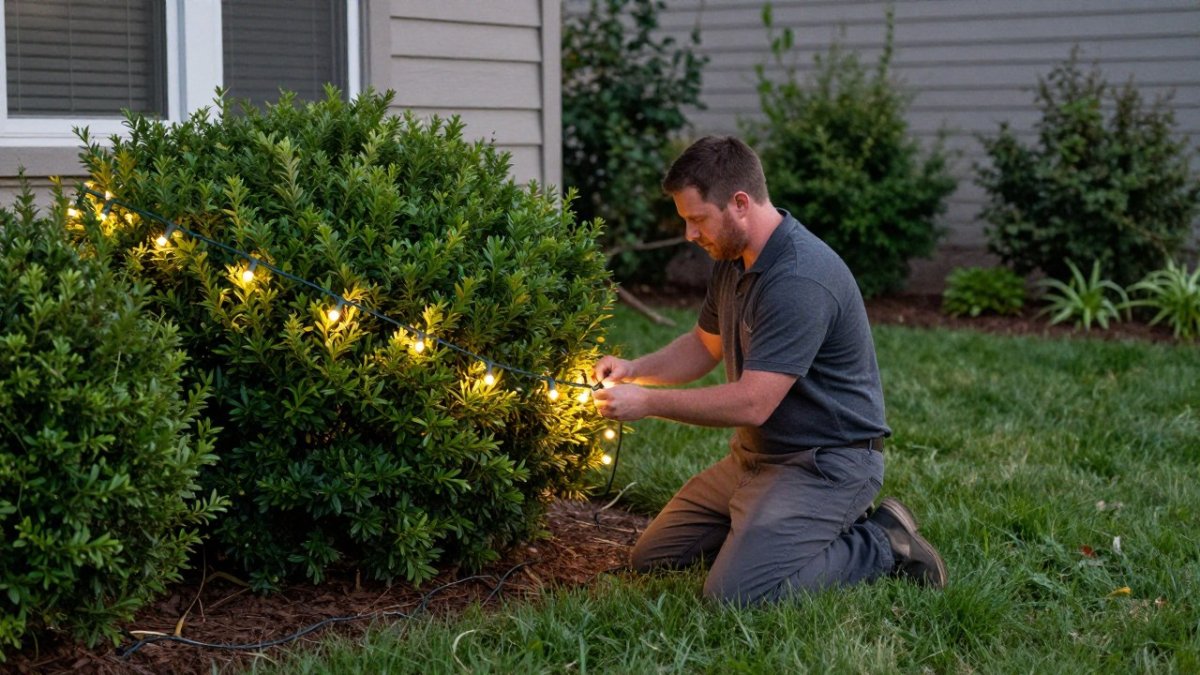
Use mulch to define beds and hide low wires
For more ways to boost your winter curb appeal, see our guide to holiday curb appeal ideas.
Drought-Tolerant Landscaping Plants by Role: Trees, Shrubs, Grasses, and Ground Covers
Think in layers. A good drought-tolerant landscaping plants list covers every height, so your display has a bottom, middle, and top. Match each plant to its water requirements and heat tolerance, and give each enough room to reach mature size.
Trees and Tall Shrubs: The Light Frame
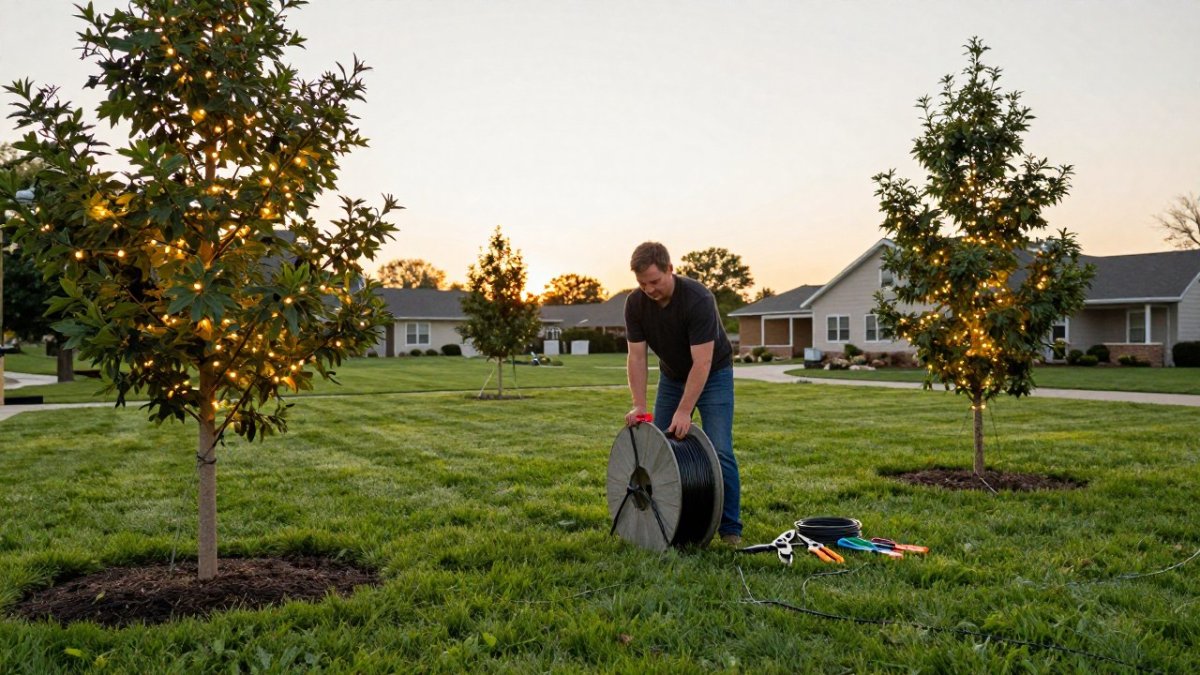
Upright trees and tall shrubs are what you wrap, uplight, and silhouette against the winter sky. Choose species with clean trunks and strong outlines.
Crepe myrtle, smooth, multistemmed trunk that takes wrapping well; most varieties reach 15-25 feet and prefer full sun. Hardy in USDA zones 6-9.
Juniper, tight cone or columnar form; many cultivars stay under 15 feet, which keeps lights within reach. Hardy zones 3-9 depending on species.
Wild lilac (ceanothus), fast-growing evergreen shrub, 6-10 feet, with a dense habit that reads well when uplit. Hardy zones 7-10.
Space tall shrubs 4-6 feet apart on center so they read as a mass but still let you walk between them with a light strand. Plant trees at least 8-10 feet from the house so branches do not scrape siding or gutters.
Mid-Height Shrubs and Perennials: Soft Texture
This layer carries the glow at eye level and softens the transition between ground and canopy.
Rosemary, upright or trailing forms, 2-4 feet; needs sharp drainage and full sun. Hardy zones 7-10.
Russian sage, airy silver stems, 3-4 feet; cut back in late winter so new growth stays dense. Hardy zones 4-9.
Butterfly bush, arching habit, 4-8 feet; prune hard in early spring for bigger blooms. Hardy zones 5-9.
Set perennials 12-18 inches apart; they fill in within two seasons and leave room for stakes and clips.
Grasses: Movement and Low Light
Ornamental grasses catch even simple strands and move in the wind, which makes a static display feel alive.
Blue fescue, 8-12 inches, clump-forming, evergreen in mild winters. Hardy zones 4-8.
Switchgrass, 3-6 feet, upright and sturdy; stands through snow. Hardy zones 3-9.
Little bluestem, 2-3 feet, blue-green summer color and bronze winter tone. Hardy zones 3-9.
Leave grass standing through winter for structure, then cut back to 4-6 inches in late winter before new growth starts.
Ground Covers and Succulents: The Base Layer
Low plants hide cords, edge paths, and fill the base of a display.
Sedum, many cultivars from 4-24 inches; most need full sun and sharp drainage. Hardy zones 3-9.
Creeping thyme, 2-4 inches, tolerates foot traffic between stepping stones. Hardy zones 4-9.
Ice plant, 3-6 inches, fast-spreading, needs full sun. Hardy zones 5-9.
Native, Mediterranean, and Regional Selection
Native plants and naturalized plants need less water and less care once established because they evolved with local rainfall and soil. Mediterranean plants like rosemary, lavender, and olive thrive in dry, sunny spots with sharp drainage.
A common pattern is to build the backbone from species native to your region and fill gaps with Mediterranean-adapted plants that share the same water needs.
For more design inspiration, browse our holiday lighting design ideas.
Here is how the article's plant picks break down by role, size, and hardiness zone.
Plant | Role | Size | Hardy zones |
Crepe myrtle | Tree or tall shrub | 15-25 feet | 6-9 |
Juniper | Tree or tall shrub | Many cultivars under 15 feet | 3-9 |
Wild lilac (ceanothus) | Tall shrub | 6-10 feet | 7-10 |
Texas sage | Tall shrub | 4-6 feet | 8-11 |
Rosemary | Mid-height shrub | 2-4 feet | 7-10 |
Russian sage | Mid-height perennial | 3-4 feet | 4-9 |
Butterfly bush | Mid-height shrub | 4-8 feet | 5-9 |
Blue fescue | Ornamental grass | 8-12 inches | 4-8 |
Step 3: Group Plants by Water Needs and Plan Your Light Runs
Grouping plants by water needs is the heart of water-wise gardening. Put thirsty plants together and dry-loving plants together. Then water one zone and leave the other alone.
Zone by Water Need, Not by Plant Type
Sketch your beds and mark each zone as dry, medium, or wet. Place drought-tolerant plants in the dry zones, group succulents and cacti on the driest, sunniest spots, and plan irrigation lines only for the thirstier zones. Route light runs along paths and bed edges, away from sprinkler heads.
A simple three-zone plan works for most residential yards:
Dry zone, highest ground, near paving, or on a slope. Succulents, rosemary, lavender, yarrow, and ornamental grasses.
Medium zone, flat beds with average soil. Most native perennials, coneflower, and butterfly weed.
Wet zone, low spots and downspout outlets. Water-loving plants, or regrade and add drainage before planting anything.
Establishment Watering vs. Mature Watering
New plants need more water than established ones, and the difference is bigger than most homeowners expect.
First two weeks: water deeply at planting, then every 2-3 days if there is no rain. Keep the root ball moist but not soggy.
Weeks 3-12: water once or twice a week, deeply enough to soak the root zone. Shallow daily sprinkling encourages weak roots.
After the first year: most drought-tolerant plants need water only during extended dry spells, often every 2-3 weeks in summer, or none at all once mature.
Water in the early morning so foliage dries before evening. Drip irrigation or soaker hoses deliver water to the root zone with far less evaporation than overhead sprinklers, and they keep cords and fixtures dry.
Estimate Your Water Savings
You do not need an exact number to see the benefit. Compare a traditional lawn-and-bed schedule (frequent, shallow watering across the whole yard) with a zoned water-wise schedule (deep, infrequent watering on selected zones).
Rainwater Collection and Light-Run Routing
Add rainwater collection where you can. A simple barrel near a downspout gives you free water for new plants during plant establishment.
Route light runs along the same paths and bed edges you use for irrigation, but keep them on the dry side of the line.
If you would rather hand off the install, our guide to professional holiday lighting installation explains what to expect.
Designing a Drought-Tolerant Front Yard That Carries a Holiday Display
A drought-tolerant front yard should look good in every season, not just December. Build around strong shapes and repeat them. Color and texture carry the design when flowers fade.
Start with a clear frame:
Line the walk with low ground covers and mulch
Place tall trees and shrubs at the corners for balance
Add ornamental grasses for soft movement
Then plan lights to follow those lines. A display that traces your beds and paths looks intentional. One that crisscrosses the lawn looks random. For more front yard ideas, see our holiday lighting design ideas.
Step 4: Safely Route Lighting Around Water-Wise Garden Features
Safety comes first around plants, water, and power. Route cords and fixtures so nothing crosses a wet spot, a sprinkler head, or a pathway where someone might trip.
Follow these rules:
Keep cords off the ground where water pools
Use stakes and clips, not nails, on trees and shrubs
Keep fixtures away from irrigation heads and rainwater collection barrels
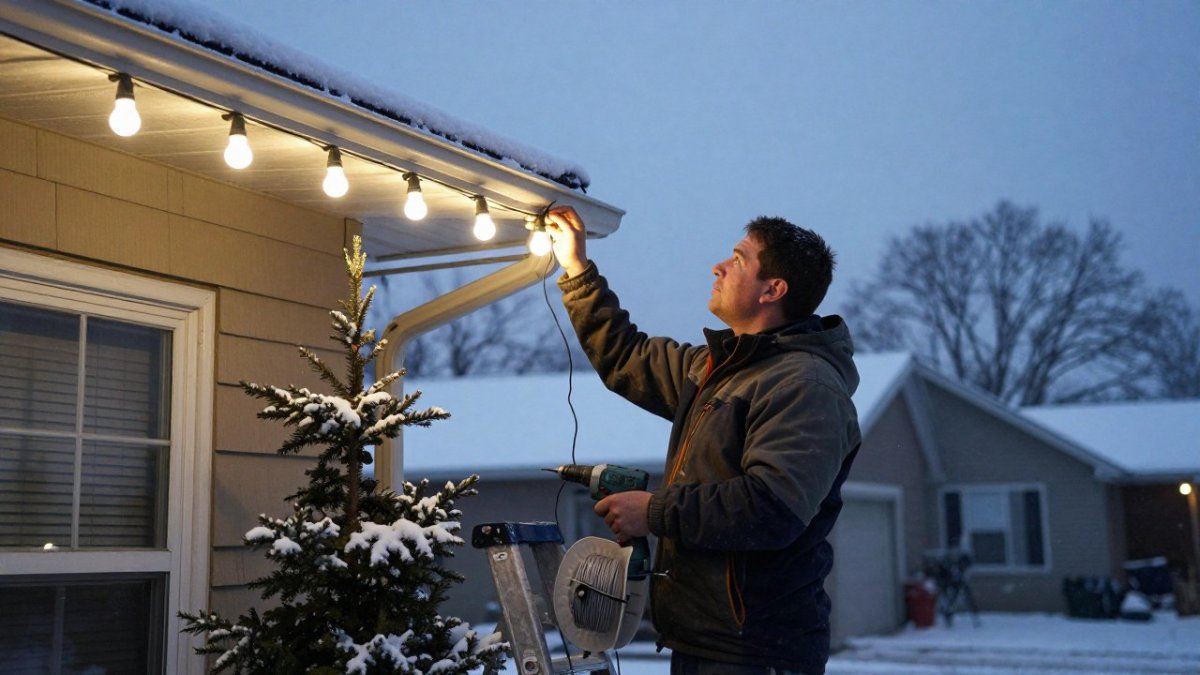
For a full walkthrough, read how to hang roofline lights safely. Watch out: stapling or nailing into a trunk can girdle a tree and kill it over time.
Bring Your Yard and Your Lights Together
Getting drought-tolerant plants and a holiday display to work as one plan takes a little thought up front.
That is exactly the kind of joined-up work we do at AF Lawn and Light.
Ready to make your yard glow without the guesswork? AF Lawn and Light pairs healthy, water-wise landscaping with custom holiday lighting, all from one team.
Frequently Asked Questions
How do I incorporate drought-tolerant plants into an existing garden?
Start by mapping the dry zones: south- and west-facing beds, slopes, and areas under wide eaves. Replace thirsty annuals in those spots first with drought-tolerant landscaping plants such as sedum, yarrow, or ornamental grasses, keeping the existing irrigation zones intact. Plant in fall so roots establish before summer, and add 2 to 3 inches of mulch. Leave the established plants in place and expand gradually, one bed per season, so your holiday lighting layout stays familiar while the planting shifts underneath it.
How should I group drought-tolerant plants in a residential landscape?
Group by water need rather than by color or size. Put succulents, agave, and cacti in the driest, sharpest-draining bed, mid-need plants like Russian sage and purple coneflower in the next zone, and any thirstier accents closest to the house where irrigation reaches easily. This hydrozoning lets one irrigation schedule serve each bed without overwatering the dry-lovers. It also simplifies holiday lighting because each zone gets its own light run and timer, so you are not stringing cords across plants with different care needs.
How often should I water drought-tolerant plants after planting?
Newly planted drought-tolerant plants still need regular water for the first season while roots spread. Water deeply at planting, then roughly once a week during the first summer, tapering as the plant shows new growth. In following years, most established plants in a Kansas City-area bed need water only during long dry spells. Deep, infrequent watering pushes roots down and builds the drought tolerance you planted for. Check soil moisture with a finger or trowel before watering rather than following a fixed calendar.
Will holiday lights damage drought-tolerant plants?
Lights themselves rarely harm plants, but the installation can. Avoid wrapping trunks tightly with wire or stapling cords into bark, which opens wounds on trees and shrubs. Clip lights to branches rather than binding them. Keep cords off the soil in beds with succulents and ground covers so foot traffic and moisture do not crush them. Have lights removed promptly after the season so ties and clips do not girdle growing branches in spring.
Comments